
Digital Marketing Trends 2026: What’s Ahead for Canadian Businesses
Canadian businesses are watching the ground shift beneath their feet. Digital marketing trends 2026 aren’t subtle suggestions. They’re requirements for staying visible while your competitors lean into AI search and zero-click discovery.
You’ve probably noticed your Google Analytics showing fewer clicks even though your rankings look solid. You’re wondering whether your social ads are reaching humans or just feeding algorithms. And you’re definitely questioning whether that blog content you’ve been churning out is even being read or just summarized by ChatGPT for someone who never visits your site.
These questions don’t signal failure. They signal evolution.
AI Search Is Replacing Traditional SEO
Your rankings might look fine.
Your website traffic probably doesn’t.
That’s the disconnect a lot of Canadian businesses are running into right now. Pages are holding position in Google, yet fewer people are clicking through. Leads feel slower. Visibility feels… thinner.
2026 is showing us a major behaviour shift.
Search engines are answering questions directly. AI tools summarize entire pages before anyone visits a site. Someone searches, “Best CRM for construction companies,” and gets a confident response without opening ten tabs or reading a single blog post.
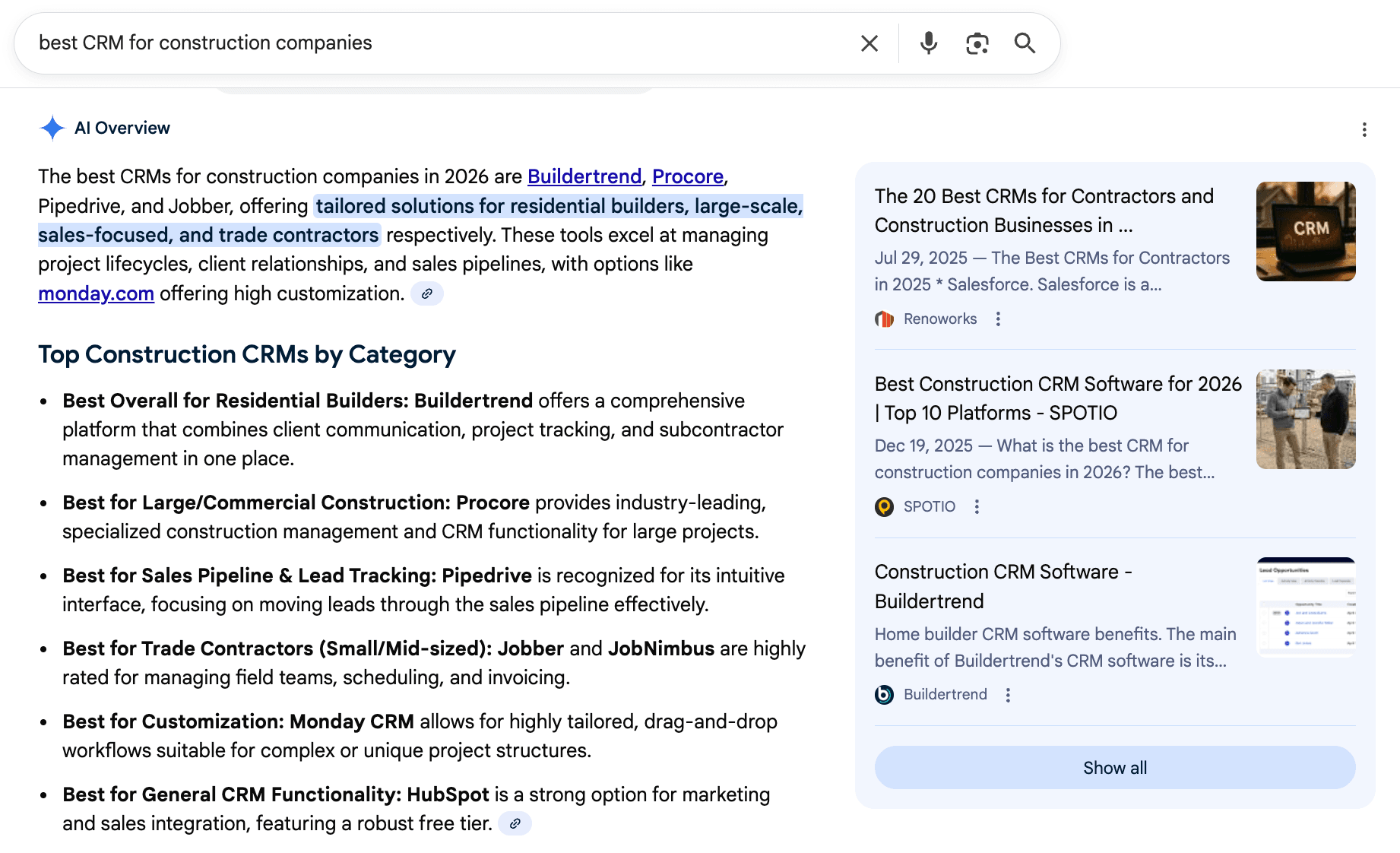
Google’s AI Overview answers the query in full before showing traditional search results. This is zero-click search in action, and it’s why your traffic might be dropping even when your rankings look solid.
This is zero-click search, and it’s becoming the default way people gather information.
That creates an uncomfortable reality. You can do SEO correctly and still lose exposure. Rankings matter, but they’re no longer the finish line. Being referenced, cited, or implied by AI-generated answers now plays a role in whether your brand is seen at all.
You can see this happening in real life. Someone asks ChatGPT for recommendations. It lists a few companies. Those names feel familiar later, even if the person never visited their websites. Brands that aren’t mentioned don’t get that advantage, no matter how well their pages are optimized.
This is one of the clearest digital marketing trends 2026 is surfacing. Search visibility is no longer just about earning clicks. It’s about being present in the answers people consume without clicking anything.
💡 For businesses, the response isn’t to abandon SEO. It’s to rethink what SEO is doing. Content needs to be structured, specific, and genuinely informative enough that AI systems can understand it and reference it.
Video Is a Primary Discovery Channel
Video shows up earlier in the buying process than most businesses expect.
Someone scrolling Instagram doesn’t think they’re researching. They’re killing time. Then a short video explains a problem they recognize. They don’t click. They don’t buy. They remember the brand. Two weeks later, when they search or ask an AI tool for recommendations, that brand suddenly feels familiar.
That pattern shows up constantly in 2026 discovery data, and it’s one of the reasons digital marketing trends in 2026 are less about channel ownership and more about repeated exposure across formats. Here’s a simple example:
A Canadian home services company posts short, unscripted videos answering common customer questions. Nothing polished. No hard sell. One video explaining why quotes vary by house type starts circulating on Instagram Reels. It doesn’t generate leads. It generates recognition. Later, when someone searches for that service or sees the company cited in AI results, the name rings a bell. Conversion happens elsewhere.
The takeaway isn’t “make more videos.” It’s to treat video as early-stage visibility, not a conversion tool. Short-form video tests messaging quickly. Longer formats like YouTube build depth once you know what people respond to. The goal is familiarity, not immediate action.
If your marketing plan still treats video as optional or purely promotional, you’re likely underestimating how many buying decisions are being influenced long before anyone clicks a link.
AI Tools Are Your Co-Pilot, Not Your Replacement
We are all starting to realize that AI is excellent at speed and volume, but terrible at emotion, culture, and nuance. AI can generate a Calgary Stampede marketing campaign in 30 seconds, but it’ll suggest “Yeehaw!” in every headline like it just discovered cowboys.
The agencies and in-house teams winning in 2026 use AI for idea generation, rapid testing, and content variation, but humans still lead strategy, messaging, and final creative decisions.
Millennials and Gen Z can easily spot AI-generated content. They’re suspicious of brands that sound robotic or generic. The brands cutting through are the ones pairing AI’s efficiency with human craft, cultural awareness, and emotional depth.
Millennials and Gen Z can easily spot AI-generated content. They’re suspicious of brands that sound robotic or generic. The brands cutting through are the ones pairing AI’s efficiency with human craft, cultural awareness, and emotional depth.
WATCH: What AI-Generated Marketing Sounds Like
If you need proof that AI can’t replace human conversation, watch this 30-second parody. It’s uncomfortably accurate.
Don’t let AI write your final content. Use it to brainstorm, outline, and create variations. But always have a human filter that injects empathy, personality, and brand truth before anything goes live.
Discovery and Purchase Don’t Happen in the Same Place
People don’t meet brands and buy from them in one tidy moment anymore.
They notice you somewhere random. A Reddit comment. A short video. A screenshot a friend sends. Nothing happens right away. Days later, they search your name. Or ask ChatGPT. Or check your Instagram. Eventually, they land on your site and convert, long after the original moment of discovery.
That gap is normal now.
For audiences under 35 especially, social platforms do most of the early introducing. TikTok, Instagram, and Pinterest create familiarity. Reviews and creator content build confidence. Search often comes last, not first.
The mistake businesses make is optimizing only for the final step.
When all the effort goes into the bottom of the funnel, the earlier moments get ignored. That’s where interest is formed, even if no one clicks anything at the time.
A stronger approach looks at the whole path. Where people first notice you. Where they check if you’re legit. Where they finally decide. Then you show up in those places in a way that fits the moment, instead of trying to force a sale at every turn.
Local Visibility Still Wins Against National Reach
National and international competitors can reach Canadian customers with a single click, but local businesses still have a massive advantage. Proximity, familiarity, and community trust.
Local SEO means optimizing your Google Business Profile, collecting authentic reviews, creating location-specific content, and showing up in AI-powered local recommendations.
Voice search is making local intent even more important. When someone asks Siri or Google Assistant, “Where’s the best brunch near me?” they’re looking for immediate, local options. If your business isn’t optimized for conversational, location-based queries, you’re missing walk-in traffic.
A Calgary-based HVAC company restructured their website to target neighbourhood-specific keywords like “furnace repair in Beltline” and “AC installation in Bridgeland.” Combined with consistent Google Business updates and review generation, their local search visibility tripled within six months.
💡 Claim and optimize your Google Business Profile. Encourage happy customers to leave reviews. Create neighbourhood-specific content that speaks to the communities you serve. And optimize for conversational, question-based search queries people actually speak out loud.
Social Commerce Is Merging Discovery and Purchase
The line between scrolling and shopping is disappearing. Instagram, TikTok, and Facebook now offer direct purchase options embedded in posts, stories, and live streams. Canadian brands using social commerce see higher engagement because they’re removing friction from the buying process.
Influencer marketing is also maturing. In 2026, mega-creators with millions of followers are commanding longer-term partnerships instead of one-off sponsored posts. Smaller creators with niche audiences are delivering better ROI for brands targeting specific communities or interests.
Canadian influencer spending hit $660 million in 2025. And that number keeps climbing because consumers trust recommendations from people they follow more than traditional advertising.
💡 If your products or services can be visually showcased, test social commerce features. Partner with creators who genuinely align with your brand rather than chasing follower counts. And create content that’s designed for discovery and purchase in the same moment.
Retail Media Networks Are the New Ad Frontier
Retail Media Networks (advertising platforms operated by retailers like Walmart, Amazon, and Loblaws) are becoming essential for Canadian brands. These platforms let you advertise directly to shoppers who are already in buying mode, using first-party purchase data for targeting.
RMNs deliver 1.8x better results than traditional digital ads and nearly 3x better results for purchase intent. Why? Because you’re reaching people when they’re actively shopping, not interrupting them while they’re scrolling.
If your product is sold through major retailers, advertising on their RMN puts you in front of customers who are already comparing options in your category. And because these platforms use closed-loop measurement, you can track ad exposure directly to verified purchases, something traditional advertising can’t offer.
💡 If you sell physical products, explore retail media networks. Test campaigns, measure ROAS (Return on Ad Spend), and track new-to-brand metrics to see whether you’re reaching new customers or just shifting existing ones.
Immersive Tech (AR/VR) Is Moving From Novelty to Normal
Augmented Reality (AR) and Virtual Reality (VR) are no longer futuristic concepts. They’re practical tools Canadian businesses are using to reduce returns, boost conversions, and deepen customer engagement.
AR try-on features let customers see how products look before buying, whether it’s sunglasses, furniture, or makeup. Virtual tours let service businesses showcase spaces without requiring in-person visits. And VR showrooms create immersive brand experiences that build emotional connection.
Adoption is still early, but the brands testing AR and VR now are positioning themselves as innovators while competitors wait.
💡 If your product benefits from visual trial (furniture, apparel, cosmetics), add AR try-on features. If you offer services in physical spaces (real estate, event venues, clinics), create virtual tours. Start small, test, and expand based on customer engagement.
Where to Focus Heading Into 2026
Digital marketing trends in 2026 aren’t abstract predictions. They’re happening right now, and the businesses that adapt early will have a measurable advantage over the ones that wait.
→ Audit your current visibility in AI tools.
Search for questions in your industry in ChatGPT, Perplexity, and Google’s AI Overviews. Are you mentioned? If not, your content isn’t AI-readable yet.
→ Create video content.
Start with short-form social videos to test messaging, then expand into longer formats and explore CTV advertising if your budget allows.
→ Use AI as a tool, not a replacement.
Let AI handle ideation and volume but always filter final content through human judgment for authenticity and cultural relevance.
→ Optimize for local search.
Update your Google Business Profile, generate reviews, and create neighbourhood-specific content that speaks to the communities you serve.
→ Test social commerce and RMNs.
If your product fits, experiment with shoppable posts and retail media platforms to reach people in buying mode.
→ Map your decoupled customer journey.
Identify every touchpoint where customers discover, validate, and purchase, then show up consistently in each space.
If you’re not sure where to start, or if you want someone to audit your current strategy against these trends, talk to our team. We help Canadian businesses navigate digital marketing trends and transitions every day.
Related articles
You may also like these

Digital Marketing,Featured,Website Design
/
6 min read
Most service businesses that come to us aren't struggling to get website traffic—they're struggling to turn that traffic into website [...]

Digital Marketing,Social Media
/
4 min read
LinkedIn document posts for B2B are one of the most underused content formats on the platform, and the results we’ve [...]

Digital Marketing
/
13 min read
You've scheduled meetings with three digital marketing agencies in Calgary. Their websites look professional. Their case studies sound impressive. They [...]
AI,Digital Marketing
/
13 min read
You've built something real. Your product works. Your service delivers. But when potential customers search for what you offer? Crickets. [...]